
Introduction
Getting the in-licensing discount rate wrong doesn’t just misprice a single pharmaceutical or biotech deal—it can quietly reshape a company’s entire portfolio risk profile over time. Every in-licensing decision ultimately asks the same valuation question: does the deal generate a positive NPV at the appropriate cost of capital? It’s standard practice, taught in every corporate finance textbook. But applying one company-wide rate to every asset, regardless of its actual risk, is a modeling shortcut that compounds into a strategic problem nobody voted for.
 What Is the In-Licensing Discount Rate Problem?
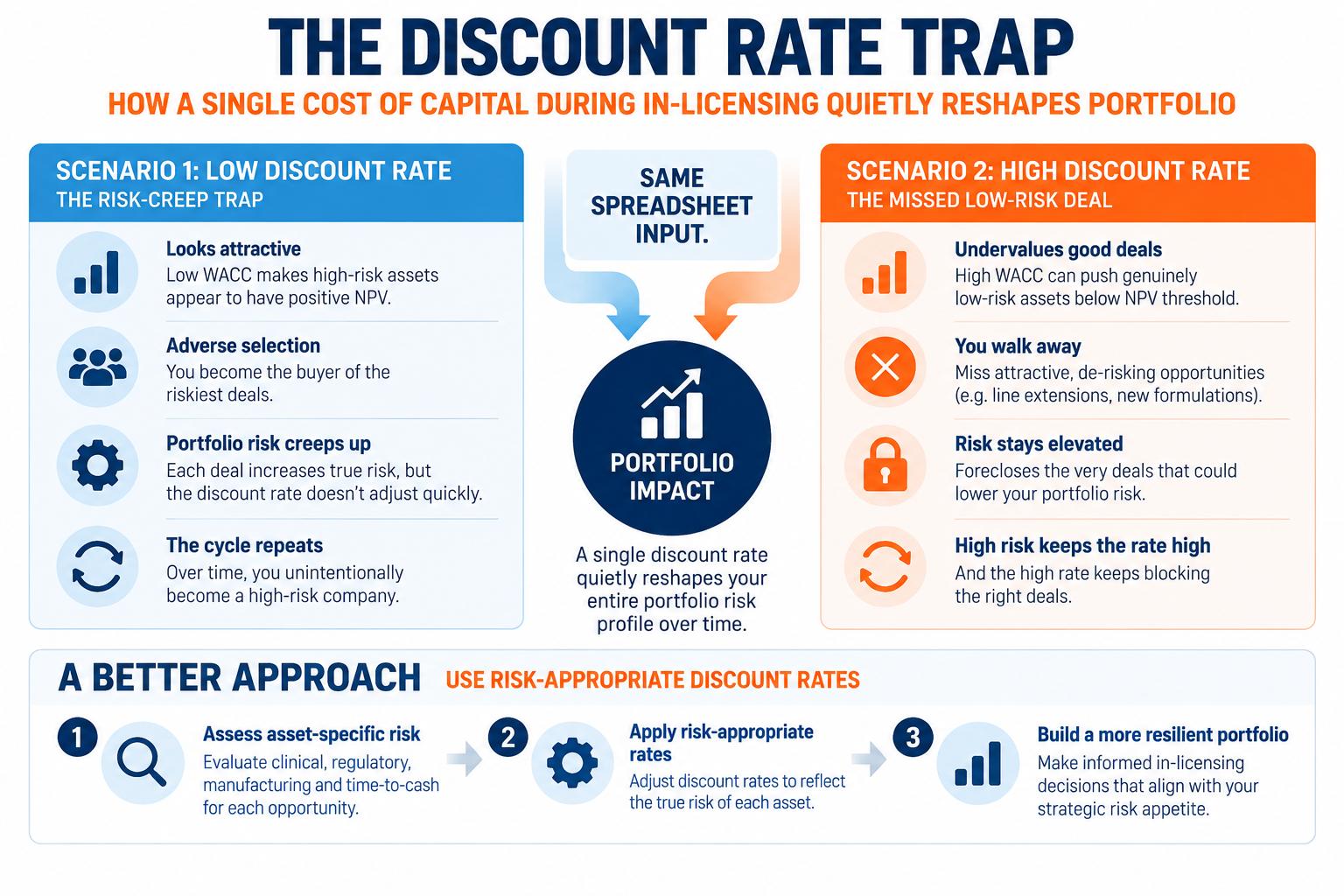 What Is the In-Licensing Discount Rate Problem?
Weighted average cost of capital (WACC) is, by design, a company-level measure. It reflects a firm’s capital structure, its existing revenue base, its credit profile, and the aggregate risk the market assigns to its current business. Damodaran’s widely-used industry cost of capital data shows just how much this figure varies within a sector—let alone across the risk spectrum of individual drug candidates.
An in-licensing decision, however, is an asset-level decision. A commercial-stage reformulation and a first-in-class gene therapy platform do not carry the same probability of technical and regulatory success, the same manufacturing risk, or the same time-to-cash-flow. Using the same discount rate for both trades accuracy for convenience—and the cost of that shortcut compounds over time.
This connects to the broader valuation discussion in The Discount Rate Conundrum and our guide to pharma and biotech discount rate methodology. The in-licensing context adds a portfolio dimension that’s easy to miss when the focus is on getting a single deal across the line.
Why Using the Same In-Licensing Discount Rate Misprices Risk
The problem isn’t the discounted cash flow (DCF) model itself. It’s the assumption underneath it: that one discount rate is an appropriate proxy for the risk of every asset a company considers in-licensing. Because that assumption goes unexamined deal after deal, it doesn’t just misprice individual opportunities—it systematically steers what kind of portfolio a company ends up with, regardless of what leadership says its risk appetite is.
The Two In-Licensing Discount Rate Traps
Scenario 1: Low Discount Rate and the Risk-Creep Trap
Consider a company with a low WACC—strong balance sheet, low leverage, a stable and de-risked existing portfolio. On paper, this is a position of strength. In practice, it creates a blind spot.
When this company evaluates a high-risk candidate—say, a preclinical gene therapy asset with substantial clinical, regulatory, and manufacturing uncertainty—applying its low rate will, more often than not, produce a positive NPV. Not because the asset is genuinely that valuable on a risk-adjusted basis, but because the rate is too low for the risk being taken on.
The consequences compound:
- Systematic overvaluation. Every high-risk asset benchmarked against a low corporate rate looks more attractive than it should.
- Adverse selection. A generous low rate makes the company the buyer of choice for the riskiest opportunities—the ones other bidders using appropriately higher rates have passed on.
- The ratchet effect. Each approved deal nudges the company’s true risk profile upward. That should raise the rate used next time. But because rates are typically set annually at the corporate level, valuation discipline doesn’t catch up—so the cycle repeats.
Over several cycles, a company that never intended to become a high-risk advanced-modality shop finds itself exactly there—not through a deliberate pivot, but through the accumulated bias of one spreadsheet input.
Scenario 2: High Discount Rate and the Missed Low-Risk Deal
The mirror image is just as damaging, and less discussed. A company with a high WACC—often because its existing portfolio already carries elevated risk—evaluates a genuinely low-risk candidate: a line extension, a new formulation of an approved mechanism, an asset with an established safety profile. Applying the company’s high rate deflates its NPV below what the opportunity is actually worth.
The result: the company walks away from precisely the deal that could improve its portfolio risk profile. This forecloses the exact mechanism—acquiring genuinely lower-risk assets—that could bring its true cost of capital down over time. High risk keeps the rate high, and the high rate keeps blocking the deals that would lower the risk.
Why This Is a Path-Dependent Portfolio Risk, Not a One-Off Pricing Error
The direction of the error is systematic and self-reinforcing, meaning the errors don’t cancel out. They compound in one direction or the other. The feedback loop looks like this:
Discount rate choice → deal selection → portfolio risk profile → (should feed back into) cost of capital → but doesn’t, because rate-setting is static.
Because most companies set a single hurdle rate annually—rather than deal-by-deal, risk-by-risk—the loop never closes. The portfolio drifts by default, embedded in a modeling convenience never meant to carry this much strategic weight.
Worked Example: Same Cash Flows, Two Discount Rates, Opposite Decisions
To make this concrete, hold the underlying cash flow forecast constant and vary only the discount rate.
Asset A: High-Risk Gene Therapy Candidate
Projected peak-year cash flow (risk-adjusted for probability of technical success): $150M, arriving in year 8, held flat for a 10-year terminal window.
| Discount Rate Applied | Resulting NPV signal |
|---|---|
| 8% (company WACC — low-risk-profile firm) | Strongly positive — “attractive deal” |
| 16–18% (asset-appropriate rate for early-stage advanced modality) | Marginal or negative — “does not clear the bar” |
Same cash flows. Same probability assumptions. The decision flips entirely on which rate the model uses.
Asset B: Low-Risk Line Extension
Projected peak-year cash flow (high probability of technical success, near-term): $40M, arriving in year 3.
| Discount Rate Applied | Resulting NPV signal |
|---|---|
| 15% (company WACC — higher-risk-profile firm) | Marginal or negative — “pass” |
| 8–9% (asset-appropriate rate for a low-risk, late-stage asset) | Clearly positive — “attractive, de-risking deal” |
Worth noting: the widely-cited DiMasi, Grabowski, and Hansen analysis of pharmaceutical R&D economics capitalized development costs at a real discount rate of 10.5%—a reminder that even academically-derived benchmark rates are stage- and risk-context-specific, not universal constants (DiMasi et al., Journal of Health Economics, 2016).
Root Cause: Conflating Cost of Capital With Asset-Specific Risk
WACC answers: what does it cost this company to raise capital, given its current business? That’s a financing question. The in-licensing evaluation needs a different question answered: what return does this specific asset’s risk profile require? That’s a valuation question, and the two are only the same by coincidence.
This conflation persists for practical reasons:
- Simplicity. A single hurdle rate is easy for investment committees to apply consistently.
- Absence of a risk-tiering policy. Most BD valuation frameworks don’t formally differentiate rates by modality, stage, or risk class—see our related discussion of valuation best practices and terminal value considerations in pharmaceutical valuation.
- Governance inertia. Revisiting a rate deal-by-deal feels like it slows the process down—ironic, given what’s at stake in getting it wrong.
How to Set an Asset-Appropriate In-Licensing Discount Rate
1. Build a risk-tiered discount rate matrix. Differentiate rates by modality and stage—preclinical gene/cell therapy, clinical-stage biologics, late-stage small molecule, approved-product line extension—benchmarked against comparable cost-of-capital data for each risk class.
2. Require dual NPV disclosure: Present NPV at the company WACC alongside NPV at an asset-appropriate, risk-adjusted discount rate. While sensitivity analysis can illustrate the impact of different discount rates, a risk-tiered approach more explicitly reflects the asset’s risk-reward profile.
3. Address the macro element in WACC. WACC incorporates the risk-free rate, which is influenced by government bond yields. Monitor changes in interest rates and Fed policy, and update WACC assumptions accordingly.
4. Recalibrate rather than set-and-forget. As portfolio composition shifts, the risk-tier table should be revisited—see our comparative evaluation framework for licensing and partnering deals and scientific due diligence guide.
5. Track portfolio-level risk exposure as an explicit governance metric, independent of individual deal NPVs.
6. Default to rNPV over a flat-rate DCF wherever probability of success varies meaningfully by stage. Risk-adjusted NPV separates probability of technical success from time value and systematic risk, rather than burying both in one number. Covered in depth in our guide to pharma and biotech valuation methods.
7. Apply real options thinking to staged or milestone-gated structures. Where a deal includes the option to abandon, expand, or delay based on interim data, a single-point DCF understates the value of that flexibility. See WIPO’s overview of real options methodology in biotech.
Governance Checklist for In-Licensing Discount Rate Decisions
- Does the rate reflect the asset’s risk, or only the company’s aggregate risk?
- Would this deal still clear the bar at a risk-tier-appropriate rate rather than the blended corporate WACC?
- Has anyone modeled how this deal shifts the portfolio’s aggregate risk profile if approved?
- Is the rate consistent with rates applied to comparable-risk assets in the past 12–24 months?
FAQs on In-Licensing Discount Rates and Portfolio Risk
Should a company use WACC as the discount rate for every in-licensing deal?
WACC reflects the company’s aggregate financing cost, not the specific asset’s risk. Using it uniformly overvalues high-risk assets and undervalues low-risk ones.
How should a company choose an in-licensing discount rate?
The discount rate should reflect the asset’s specific risk profile, including development stage, modality, regulatory and manufacturing risk, time to cash flow, and relevant market risk. Companies can formalize this through a risk-tiered discount rate framework and compare the resulting NPV with NPV calculated at the corporate WACC.
How often should a company revisit its in-licensing discount rate assumptions?
At minimum, annually—and whenever the composition of the existing portfolio shifts meaningfully toward higher or lower risk. It should also be updated immediately if government bond yields change materially, since that shift feeds directly into the cost of capital.
What’s the difference between NPV and rNPV in licensing valuation?
NPV discounts projected cash flows at a single rate. rNPV additionally weights those cash flows by stage-specific probability of technical and regulatory success, separating clinical risk from the discount rate itself.
Conclusion: NPV Is Only as Honest as the Discount Rate Behind It
A single cost of capital applied indiscriminately across every in-licensing candidate isn’t a neutral simplification. It’s a hidden portfolio strategy, executed by default—quietly pushing low-WACC companies toward risk accumulation and high-WACC companies away from the deals that could reduce their risk over time.
The fix isn’t more complex modeling for its own sake. It’s matching the discount rate to the risk actually being priced, disclosing both numbers to decision-makers, and tracking portfolio-level risk drift as deliberately as any individual deal’s NPV.
BiopharmaVantage, a specialist healthcare and life sciences consulting firm, provides valuation services for pharma, biotech, diagnostics, and medical device companies and investors. Contact us to learn more.