
Introduction
Due diligence (DD) in pharmaceutical licensing and M&A has always been a resource-intensive exercise. Thousands of documents – clinical data packages, IP portfolios, regulatory submissions, commercial contracts, manufacturing records, financial projections – must be reviewed, synthesized, and stress-tested within compressed timelines and under significant deal pressure. The quality of that process directly determines deal quality. Incomplete diligence is not a procedural failure – it is a financial one, often discovered months after close when the liability it missed materializes.
In 2025, pharma M&A exceeded $240 billion — an 81% surge on the prior year — and licensing deals topped $250 billion across 516 transactions. Behind every successful deal in that cohort was a diligence process that identified what mattered. Behind many of the failures – collapsed acquisitions, terminated licenses, post-close write-downs – lay due diligence that moved too fast, covered too little, or drew the wrong conclusions from the data it did review.
Artificial intelligence (AI) is now materially changing the economics and execution of pharmaceutical due diligence. The shift is not cosmetic. It is structural – and its implications for BD and licensing teams, legal advisors, and biotech founders preparing for partnership are significant enough to warrant careful assessment.
The Problem AI Is Solving in Pharma Due Diligence
The structural problem with traditional pharma due diligence is the mismatch between data volume and available time. A typical licensing data room for a Phase 2 or Phase 3 asset contains hundreds to thousands of documents spanning multiple functional domains. A full-scope diligence review – scientific, regulatory, IP, commercial, financial, and legal – requires specialist input across each of these domains, coordinated under a deal timeline that rarely accommodates the depth of analysis that each dimension warrants.
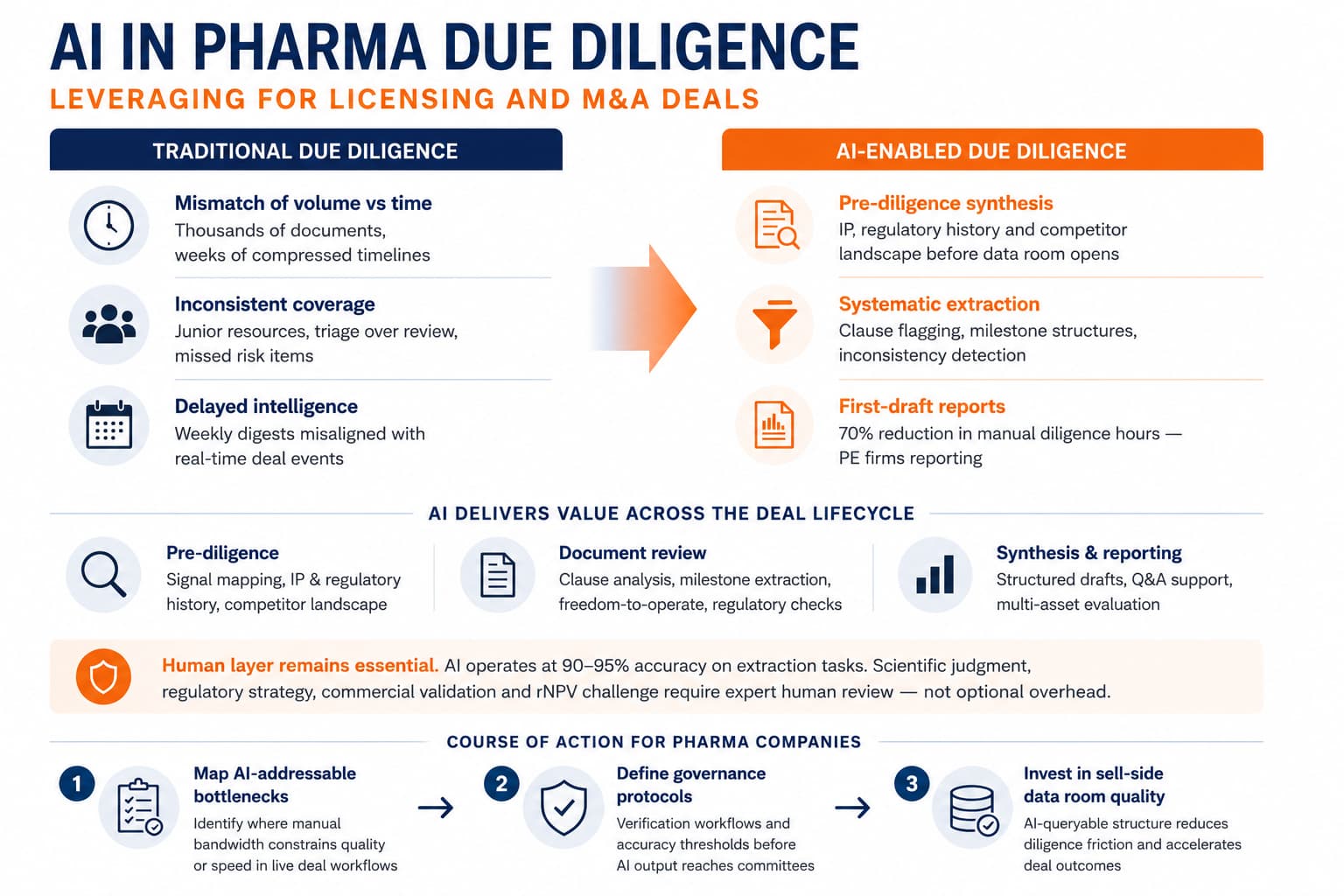
The consequence is well understood by anyone who has been through the process: coverage gaps. Documents are triaged rather than reviewed. Junior resources handle first-pass review under time pressure. Key risk items buried in subsidiary agreements or technical appendices are missed not because they were concealed but because the human bandwidth to surface them was insufficient. Traditional due diligence fails because it relies on human analysts to manually review thousands of documents under extreme time pressure, which guarantees inconsistent coverage, missed risks, and blown deadlines.
AI addresses this at the point where the problem is most acute – not by replacing expert judgment but by eliminating the manual, repetitive extraction work that consumes the majority of diligence hours while contributing the least analytical value.
What AI Is Delivering in Biopharma Due Diligence
The practical applications of AI in pharmaceutical due diligence fall into three categories, each delivering measurable value at different stages of the process.
Pre-Diligence Intelligence Synthesis
Before a data room opens, AI systems can synthesize publicly available information – regulatory filings, clinical trial registries, patent databases, scientific literature, and competitor pipeline data – into structured assessments that give deal teams a substantive head start. This application integrates directly with the competitive intelligence function. A buy-side team that enters a data room already having processed the public competitive landscape, the IP position, and the regulatory history of a target asset is not starting from zero. It is directing its limited diligence bandwidth toward the questions the public record cannot answer.
Systematic Document Review and Extraction
AI systems applied to data room content can read, classify, and extract key terms and provisions from large document sets with a consistency and thoroughness that human review cannot match at equivalent speed. AI-powered tools can rapidly analyze thousands of documents, flagging key clauses such as change-of-control provisions, anti-assignment clauses, most-favored nation clauses, and non-compete restrictions – expediting first-level review and ensuring that the internal due diligence team can spend their time interpreting risks and applying judgment rather than simply locating them. In a specific asset licensing context, the equivalent applications include extracting milestone structures and payment triggers from existing license agreements, identifying IP encumbrances and freedom-to-operate constraints, and flagging inconsistencies between regulatory submissions and clinical data summaries.
Accelerated First-Draft Synthesis
McKinsey’s survey of M&A practitioners found that those using generative AI report an average 20% cost reduction, with 40% reporting 30 to 50% faster deal cycles. The most advanced implementations now involve AI generating structured first-draft diligence reports directly from data room content – formatted to the deal team’s preferred structure, guided by prior reports on comparable transactions, and covering the full scope of uploaded materials. Private equity firms using AI-assisted document parsing report up to 70% reduction in manual diligence hours. For pharma licensing teams managing multiple simultaneous evaluations – a common position for active BD functions during peak deal periods – this compression of first-pass review time is not a marginal improvement. It is a capacity multiplier.
The Accuracy Question and the Human Layer in AI-enabled Pharma Due Diligence
The most important caveat in any discussion on leveraging AI in pharma due diligence is the question of accuracy – and it deserves a precise rather than a generalized answer.
The answer depends on the nature of the decision the diligence is informing. In-house teams and external consultants often operate at higher volumes and have more flexible accuracy thresholds. As a result, 95% accurate first drafts are both acceptable and valuable, as AI enhances throughput and frees teams to focus on strategic issues rather than data extraction.
In pharmaceutical licensing specifically, the implications of a missed diligence finding can range from material – such as clinical trial metrics that limit commercialization relative to competitors – to deal-affecting, such as a CMC issue that renders a clinical program’s commercial projections unreliable. AI systems operating at 90% accuracy are well-suited to first-pass extraction and flagging. However, they are not a substitute for expert human review of findings that impact risk assessment, probability of success, and ensuing valuation.
AI cannot independently challenge the peak sales projections provided by the selling party with the skepticism that experienced practitioners apply. Independent human validation of market size, market share assumptions, and pricing is essential – many deals have been overvalued because the acquirer accepted optimistic commercial projections from the licensor, target company, or sell-side advisors without conducting their own bottom-up analysis.
For these reasons, human intervention – especially in regulatory and scientific due diligence and commercial due diligence – remains paramount. AI excels at data extraction and pattern recognition across large document sets. It does not replicate the clinical expertise required to assess whether a Phase 2 dataset is genuinely fit for purpose, the regulatory judgment required to evaluate the robustness of a filing strategy with the FDA and EMA, or the commercial insight required to challenge the assumptions underpinning a revenue forecast. The human expert layer is not optional overhead in an AI-assisted process. It is the mechanism by which AI-generated findings are converted into decision-ready conclusions.
Implications for Pharma BD and Licensing Teams
The operational implications of AI in due diligence are not limited to speed, cost, and efficiency. They are strategic – and they advantage the teams that implement AI systems and practices fastest.
McKinsey estimates that within two years, generative AI tools will improve enough to make diligence a continuous and connected part of the deal cycle. Deal teams that can compress diligence timelines through AI-assisted review can move to term sheet faster, present stronger bids with higher analytical confidence, and sustain evaluation of a larger number of simultaneous opportunities than teams operating on traditional manual timelines. In competitive auction processes – a structural feature of the most sought-after pharma assets – that speed advantage is directly reflected in deal outcomes.
The second implication is for data room preparation on the sell side. A data room that is comprehensively organized, clearly indexed, and AI-queryable reduces the friction of the buyer’s diligence process – which translates directly into deal velocity and buyer confidence. A well-organized data room with clear folder structures, indexed documents, and AI-powered search can reduce total advisor costs by 20 to 30%. For a biotech preparing for its first out-licensing transaction, this is a preparation investment that pays a direct return – a faster, smoother diligence process is a credibility signal to potential partners and reduces the timeline risk that erodes rNPV in any licensing deal. This is consistent with the broader principles we describe in our guide to pharma and biotech out-licensing and partnering.
The third implication is for the integration of diligence with other functions, such as insights, competitive intelligence and information services. AI systems that can query data room content in natural language – asking “what are the key IP encumbrances on this asset?” or “what manufacturing risks are disclosed in the CMC package?” – operate on the same architectural logic as agentic AI systems monitoring the competitive landscape and the wider external environment. Pharma companies that have invested in building internal AI-powered capabilities are in the strongest position to extend that infrastructure into the diligence function. The data sources are different; the analytical architecture is the same – and this integration represents one of the clearest synergies in deploying AI across pharma. Our comparative evaluation frameworks for licensing and partnering deals are specifically designed to bridge this integration.
Course of Action for Pharma Companies
Several pharma companies have already implemented capabilities to use AI in pharma due diligence. In fact, virtual data room providers now routinely allow clients to integrate AI agents directly into their platforms. For those who have not yet started, three practical steps follow from this analysis.
The first is to map current diligence workflows against AI-addressable bottlenecks. The highest-value applications of AI in pharma due diligence – pre-diligence intelligence synthesis, systematic document extraction, and first-draft report generation – are immediately deployable. Deal teams should identify where manual bandwidth is currently constraining diligence quality or speed and prioritize AI integration at those precise points.
The second is to establish governance and verification protocols before deploying AI in live transactions. An AI-generated finding that reaches a deal committee without human expert verification is a liability, not an asset. Verification workflows, accuracy thresholds, and human review responsibilities should be defined as infrastructure – not added as an afterthought when a deal is already in motion.
The third is to invest in sell-side data room quality as a strategic priority, not a last-minute preparation task. Licensors that approach BD with a comprehensively organized, AI-queryable data room compress their partner’s diligence burden and signal the operational maturity that sophisticated licensees are evaluating alongside the asset itself. In a competitive licensing process, this distinction is visible and consequential.
The Transition Is Already Underway
AI is not approaching pharmaceutical due diligence as a future application. It is already embedded in the workflows of leading deal teams. According to Bain & Company, 21% of M&A professionals were already using generative AI tools in transaction processes as of 2025, with the expectation that nearly every step of M&A will be AI-enabled within five years.
For pharma and biotech companies whose deal timelines, valuation accuracy, and partnership credibility depend on the quality of their due diligence function, the transition is not optional and the timing is not neutral. The firms building AI-assisted diligence capability now will have a compound advantage over those that begin when the technology is no longer differentiating. As we note in our valuation and NPV frameworks for pharma assets, the financial stakes of due diligence quality in pharmaceutical transactions are too significant for the function to remain structured around processes designed for a pre-AI deal environment.
BiopharmaVantage provides specialist regulatory and scientific due diligence, commercial due diligence, competitive intelligence, valuation, and licensing and partnering services to pharmaceutical and biotechnology companies. To discuss how we can support your due diligence program, contact us.