
Introduction
In the pharmaceutical industry, information is power. Decisions on R&D, licensing, and product launches can involve investments worth millions, and relying on outdated or incomplete data is a costly risk. With the rise of AI tools, data platforms, and automation, secondary research has become baseline – company information, trial registries, publications, and analyst reports are now accessible to almost everyone. While these sources provide breadth, they rarely offer the nuance or timeliness needed for informed decision-making.
This is where primary research, also known as HUMINT (Human Intelligence) or primary competitive intelligence, a type of pharma competitive intelligence, becomes the true source of incremental competitive advantage. By engaging directly with stakeholders such as company sources, physicians, payers, regulators, patients, and industry experts, pharma companies gain exclusive, context-rich insights that no database or algorithm can match. HUMINT is what elevates proactive CI strategy above routine CI monitoring.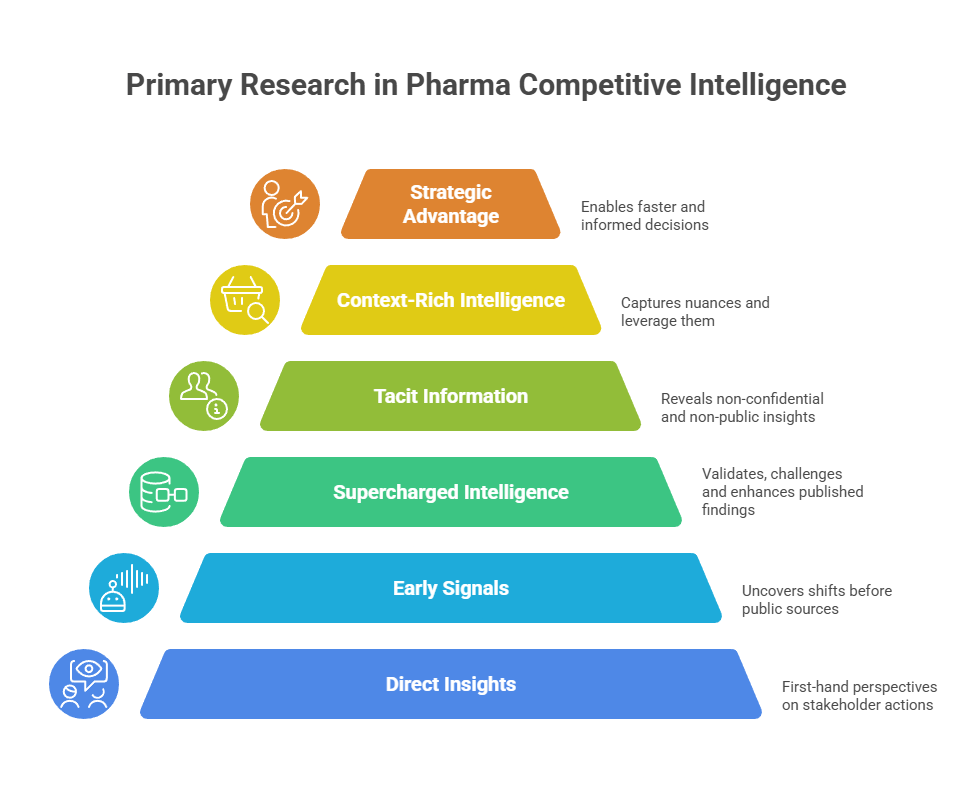
Selected Advantages of Primary Research (HUMINT) in Pharma
- Direct insights into decision-making
HUMINT captures first-hand perspectives, providing clarity on why and how stakeholders act the way they do, not just what they do. Unlike secondary data, it explains underlying drivers such as decision-making rationale, prescribing logic, adoption hurdles and more. - Early signal detection
Conversations with corporate respondents, KOLs, site investigators, and trial staff can uncover subtle shifts in trial progress, clinical sentiment, or competitive positioning long before they surface in published sources. - Supercharging secondary intelligence
While databases and reports provide breadth, HUMINT offers depth. Direct interviews validate or challenge desk-based findings and often go further, reducing reliance on assumptions or outdated data. - Access to tacit information
Stakeholder engagement with primary research often reveals non-confidential and non-public insights not yet disclosed publicly. This gives companies a critical edge in decision-making and refining their thinking. - Context-rich intelligence
Numbers alone cannot capture market nuance. HUMINT surfaces details such as a company’s priority for a new product, payer concerns about budget impact, or patient frustrations with existing therapies. Such insights shape product uptake, positioning, messaging, and clinical development priorities. - Flexibility and customization
Primary research can be designed to address highly specific business questions – from what endpoints resonate with clinicians to what evidence sales and marketing resources a company might be deploying for its asset. - Strategic advantage in decision-making
Because HUMINT provides fresh and often exclusive insights, it enables faster and more informed decisions in competitor monitoring, market entry, lifecycle management and asset evaluation.
In short, HUMINT provides an incremental competitive edge by equipping the pharma industry with forward-looking, context-rich, and exclusive intelligence that is hard to obtain elsewhere.
Limitations of HUMINT in Pharma Competitive Intelligence
Even when conducted by skilled providers, HUMINT carries inherent limitations that must be acknowledged:
- Bias and subjectivity
Stakeholder perspectives may reflect personal incentives or regional practices, which may not represent broader markets. - Small sample sizes
Primary research projects often involve a limited number of interviews, creating a risk of overgeneralisation. Primary research in the context of competitive intelligence is not subject to statistical robustness; hence, it is intelligence, not data. - Access challenges
High-value stakeholders such as company sources, regulators, payers, or investigators are often difficult to reach. - Compliance and ethics
Strict industry codes govern CI practices. Poorly executed HUMINT risks non-compliance and reputational harm. - Cost and resource intensity
Compared with secondary research, HUMINT requires more resources and investment – there is a high attrition rate, and it requires skilled interviewers, strong networks, and superior interpretation of collected intelligence and ensuing analysis. - Dependence on the interviewer’s skill
The value of HUMINT depends heavily on the expertise of the interviewer in eliciting, probing, interpreting and analyzing responses.
Challenges with Primary Competitive Intelligence Providers
Beyond the inherent limitations of HUMINT itself, the quality of insights also depends on the vendor. In practice, several issues undermine the value of primary competitive intelligence:
- Over-reliance on KOLs
Many vendors lean heavily on key opinion leaders because they are more accessible than corporate respondents. However, KOLs are often unable – or contractually restricted – from providing meaningful perspectives on commercial strategy, organizational decision-making, or competitor operations. Relying on them as the main source of primary CI risks producing insights that are incomplete or off-target. - Credibility gaps in responses
Surveys show that as much as 75% of questions in primary CI projects are answered by sources that most decision-makers would not consider credible for those specific topics. This highlights the danger of treating all respondents as equal, regardless of their domain knowledge or proximity to the intelligence being sought. - Skill imbalance in vendor teams
Many CI vendor teams are staffed primarily with individuals from life sciences or clinical backgrounds. While this expertise is valuable, it is not sufficient for extracting high-quality commercial intelligence. Gathering meaningful HUMINT from competitor organizations requires not only scientific knowledge but also commercial skills – understanding corporate structures, decision flows, and how information circulates internally. Vendors that lack this dual capability often default back to KOLs, reinforcing the cycle of limited insights. - Weak source networks
The breadth and quality of a vendor’s source network are critical. Strong networks provide both access to hard-to-reach respondents and referrals to additional credible sources. Without this, the intelligence gathered can be narrow, anecdotal, or repetitive. - Reliance on quantity rather than quality
Some providers measure the success of a CI project by the number of interviews completed rather than the calibre of respondents or the relevance of their perspectives. This creates the illusion of robustness while offering little genuine strategic value. - Limited contextual analysis
Too often, providers stop at reporting what sources said, without probing why it matters, how reliable it is, or how it fits into the broader competitive picture. Without interpretation, intelligence risks becoming a collection of anecdotes rather than actionable guidance.
These challenges explain why the quality of HUMINT varies so widely between providers. While most CI vendors claim to deliver actionable insights, truly actionable intelligence requires credible sources, balanced skill sets, robust networks and superior analysis.
Why Superior Primary Competitive Intelligence Matters
Human Intelligence (HUMINT), primary research, or primary competitive intelligence is now a critical tool for pharma decision-making. Its strength lies in uncovering motivations, early signals, and non-public insights that secondary sources cannot provide. Yet its value depends on how it is conducted. Poorly executed HUMINT can mislead, while superior primary CI in pharma can de-risk strategy and provide a genuine competitive advantage.
BiopharmaVantage specializes in providing premium quality primary competitive intelligence services and wider decision-making services to pharma, biotech and diagnostics companies. If you would like to explore how we can assist you, please contact us.